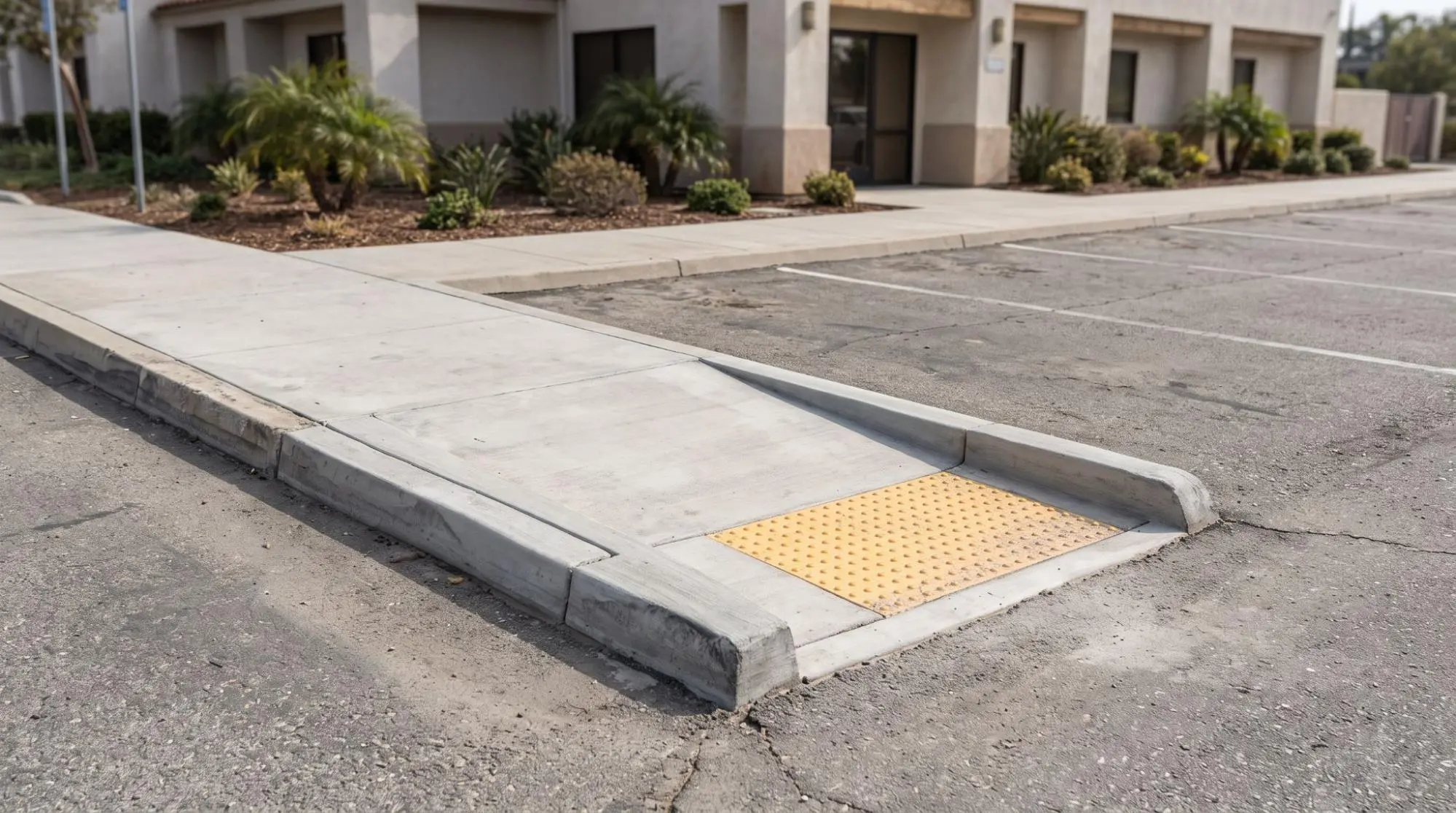
ADA Curb Ramp Compliance: Slopes, Landings & Detectable Warnings
Introduction
Curb ramps are small, but they carry a lot of responsibility. They’re the point where a sidewalk meets a parking lot, drive aisle, or street, and where visitors using wheelchairs, walkers, or canes, as well as visitors with low vision, are most exposed to changes in elevation and vehicle traffic.
Because curb ramps pack so many requirements into such a small space, they’re one of the easiest accessibility features to get wrong. Excessive slopes, inadequate landings, or damaged detectable warning surfaces can create accessibility concerns and may require corrective work to meet applicable standards.
High Standards Concrete helps commercial property owners, HOAs, and property managers throughout Southern California install and repair curb ramps that meet ADA standards and stay compliant under years of daily use.
What Makes a Curb Ramp ADA Compliant
Curb ramps are held to specific standards for geometry, surface, and how they connect to the surrounding walkway and pavement.
Key requirements typically include:
- A running slope no steeper than 1:12
- A cross slope no steeper than 1:48
- Flared sides where the ramp crosses a walking surface
- A level landing at the top of the ramp
- Minimum width for wheelchair passage
- A flush transition at the bottom with no lip or gap
- Detectable warning surfaces where required by applicable federal, state, or local accessibility standards.
A curb ramp that meets most of these requirements but misses one can still create a barrier for someone relying on it.
Understanding Detectable Warning Surfaces
Detectable warnings are the textured panels of raised truncated domes found at the bottom of curb ramps. They alert pedestrians with visual impairments that they’re about to enter an area with vehicle traffic.
To be effective and compliant, detectable warnings generally need to:
- Extend the full width of the ramp
- Meet minimum depth requirements in the direction of travel
- Contrast visually with the surrounding surface
- Use properly sized and spaced domes
- Remain securely bonded and in good condition
California adds its own requirements for detectable warnings, including specific color and dimension rules, which is why products and layouts that pass elsewhere don’t always pass here. Older surface-applied panels are also prone to loosening, cracking, and wearing down, which can create both a compliance issue and a trip hazard.
Common Curb Ramp Violations
Slopes Out of Range
Excessive slopes are a common accessibility concern, particularly where ramps were improperly constructed or surrounding surfaces have shifted over time.
Missing or Undersized Top Landings
Without a level landing at the top, wheelchair users have nowhere to turn or pause before descending, which is a frequent issue where ramps are squeezed into narrow sidewalks.
Lips and Gaps at the Bottom
Settlement, asphalt overlays, and gutter damage can leave a lip where the ramp meets the pavement. Even a small vertical edge can stop a wheelchair caster. Where these edges come from raised or shifted concrete, ADA trip hazard removal is often part of the fix.
Worn or Missing Detectable Warnings
Faded, cracked, or loose warning panels are common on older ramps, and many ramps built before current standards never had them at all.
Poor Drainage
Water that pools at the bottom of a ramp creates slip hazards and gradually erodes the concrete and surrounding pavement.
Why Concrete Quality Matters for Curb Ramps
Curb ramps take a beating from foot traffic, wheelchairs, carts, and occasional vehicle contact. Poor base preparation or inadequate reinforcement can lead to cracking and settlement that push a ramp out of compliance within a few years.
Properly installed concrete supports:
- Accurate, stable slopes over time
- Flush, durable transitions to adjacent surfaces
- Secure installation of detectable warning surfaces
- Slip-resistant surface texture
- Fewer repeat repairs
Getting the concrete right at installation is the most reliable way to keep a curb ramp compliant year after year.
Curb Ramps Connect the Whole Accessible Route
A curb ramp is the hinge between parking areas and walkways. If the accessible parking space, the ramp, and the walkway leading to the entrance don’t line up, the route fails even when each piece looks fine on its own.
That’s why curb ramp work is most effective when it’s reviewed alongside parking lot, walkway, and ramp requirements as part of one connected system. Our ADA compliance page explains how these elements fit together.
The Benefits of Compliant Curb Ramps
Improved Safety — Properly sloped ramps with clear detectable warnings reduce falls and help visitors move safely between pavement and walkways.
Reduced Liability — Curb ramps are a common focus of accessibility complaints, and correcting them proactively lowers the risk of claims and required corrections.
Better Property Reputation — Accessible, well-maintained entry points show visitors and tenants that the property is managed with care.
Potential Cost Savings — Identifying curb ramp problems during planned maintenance may help property owners avoid more extensive repairs later.
When Should a Curb Ramp Be Reviewed?
Consider scheduling a curb ramp evaluation if you notice:
- Cracked, settling, or uneven concrete at or around the ramp
- Faded, loose, or missing detectable warning panels
- A lip or gap where the ramp meets the pavement
- Standing water at the bottom of the ramp
- Upcoming parking lot resurfacing or restriping
- A recent accessibility complaint or change in property ownership
Catching these issues early usually means a targeted repair instead of a full rebuild.
Work with a Contractor Who Understands Curb Ramp Standards
Curb ramps leave very little room for error. Slopes, landings, flares, and detectable warnings all have to come together in a small footprint, and they have to meet California’s requirements as well as federal ones. High Standards Concrete has spent years helping property owners across the region build curb ramps right the first time. You can learn more about our team and approach on our About page.
Schedule an Assessment
If your property’s curb ramps are aging, damaged, or missing detectable warnings, it’s worth having them reviewed sooner rather than later. Contact us to schedule a curb ramp assessment, or visit our ADA compliance page to explore our full range of ADA-focused concrete services.
Raise your standards and create an environment that captivates those who are within it!
Raise your standards and create an environment that captivates those who are within it!
Need something to create curb appeal and great design aspects? We know what to consider when it comes to color schemes, line of sight, creating mystery and appeal, and blending these important aspects with functionality. Need something to create curb appeal and great design aspects? We know what to consider when it comes to color schemes, line of sight, creating mystery and appeal, and blending these important aspects with functionality. Need something to create curb appeal and great design aspects? We know what to consider when it comes to color schemes, line of sight, creating mystery and appeal, and blending these important aspects with functionality.